Carcassonne — The Gateway Classic
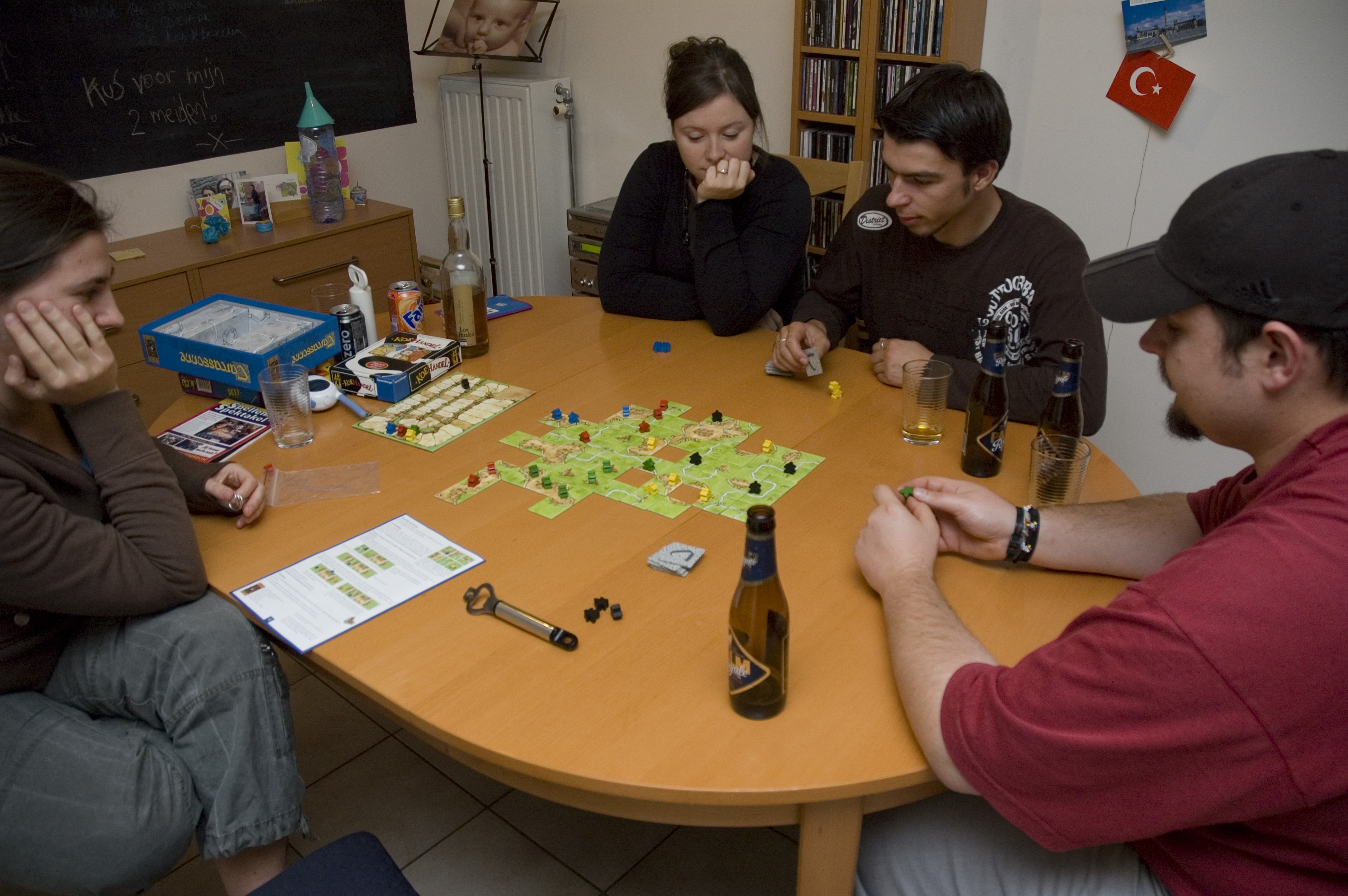
Carcassonne remains one of the most effective gateway games ever designed. Players build a medieval landscape tile by tile, placing meeple figures to claim cities, roads, monasteries and farmland. The scoring is transparent enough for children to track, but the spatial competition for shared features — especially farmland, which scores only at game end — generates genuine strategic depth once players understand what they are looking at.
The original base game (Základní hra in Czech editions) contains everything a family needs for dozens of sessions. Expansions like Inns and Cathedrals add meaningful complexity if the group grows into the game, but none are necessary early. Czech editions from Albi carry the same content as the German originals with fully localised components.
One note about teaching: the farm scoring rule confuses roughly half of all new players. Address it explicitly before the first game ends — discovering that farmland scores at the end during scoring usually produces frustration rather than surprise. Once understood, farms become the single most contested element in competitive play.
Carcassonne won the 2001 Spiel des Jahres, one of the longest-standing award winners in the event's history. The Czech edition is carried by Albi and retails for approximately 600–750 CZK.
Scrabble — Language as Strategy

Scrabble occupies a permanent space in Czech households. The Czech edition from Mattel uses a tile distribution calibrated to Czech letter frequency — Q, X and W appear rarely while common Czech letters like K, R and S appear more frequently than in the English version. The Czech board also adjusts bonus square placement slightly from the English original, though the impact on strategy is minimal.
Playing Scrabble seriously is a different experience from playing it casually with family. Competitive players maintain a working knowledge of obscure two- and three-letter words, and strategic play involves blocking high-value squares as much as maximising personal score. For families, the casual version — where dictionaries are consulted freely and challenged words are accepted if both players agree — produces a more enjoyable experience than strict tournament rules.
The game's longevity in family settings comes partly from its repeatability. No two games produce the same board, and the combination of tiles drawn introduces enough variance to keep sessions from feeling routine. It also has the advantage of requiring no setup time beyond tile distribution, which makes it practical for spontaneous evenings.
Codenames — See Full Review in Cooperative Section
Codenames appears in our cooperative section but deserves mention here as one of the most versatile family-friendly games in print. Unlike many cooperative games, it eliminates the team-leader problem entirely through its information structure, making it genuinely usable with mixed groups. See the full review in cooperative games.
Building a Starter Family Collection
A practical starter family collection for Czech players could look like this:
- First game: Carcassonne — spatial, visual, fast to explain
- Word game: Codenames — better with larger groups than Scrabble
- Longer sessions: Ticket to Ride Europe — introduces route planning
- Two-player only: Patchwork — compact, quick, good for pairs
These four titles cover most family occasions without duplicating mechanics. Each can be found in Czech editions at Albi, ADC Blackfire, or directly at board game specialty shops in Prague and Brno such as DeskoveHry.com.
A Word on Czech Game Availability
Most major international titles are available in Czech editions within six months to a year of their original release. The largest distributors — ADC Blackfire and Albi — maintain strong catalogues and regular communication with publishers. If a game you want is not yet in Czech, the German-language version is usually available faster and grammatically straightforward for Czech speakers who read German at an intermediate level.